Posts: 6
Threads: 2
Joined: 2026-03-14
We are attempting to bring online a detector in a fairly underserved region of the world. As far as I know it would be at least 1000 miles from the nearest detector. I'm interested in how this would affect the quality of measurement accuracy in the region.
Can someone point me in the direction of: - Where (geographically) would you expect the greatest improvement of accuracy (closer to the new detector)?
- Is there an explicit measure of error that would be expected to improve and where in the dataset would I find that?
Thanks.
Posts: 1,966
Threads: 64
Joined: 2013-07-23
2026-03-21, 23:58
(This post was last modified: 2026-03-22, 00:01 by cutty.)
(2026-03-21, 16:40)gmiller43 Wrote: We are attempting to bring online a detector in a fairly underserved region of the world. As far as I know it would be at least 1000 miles from the nearest detector. I'm interested in how this would affect the quality of measurement accuracy in the region.
Can someone point me in the direction of:- Where (geographically) would you expect the greatest improvement of accuracy (closer to the new detector)?
- Is there an explicit measure of error that would be expected to improve and where in the dataset would I find that?
Thanks
From the nature of your other posts, I might suggest you review all the Blitzortung documentation. No, there's no 'explicit measure of error'. It's an assumed 'deviation' of location for each stroke for each station. It IS displayed for each stroke in various map view configurations. It is a computed, assumed error based on a large number of variables mixed with hard data....
Strokes must be detected before they can be located. Assume for simplicity that it takes a minimum of 4 receivers to 'detect' a stroke, and then a 'location' computation can begin... the error here will be significant. Especially at a distance. In actuality, that number would be a minimum of 8-14 stations required.
Assume you are in a location surrounded by stations, let's say 3, in an arc, north of you. They're all 1000 miles from you. In this scenario, NO strokes can be detected, and therefore located, in your vicinity, by those three stations. They're probably receiving them, and sending them, but the 4th station is missing,... You... so all those signals are ignored at the computing server, in this example, requiring 4 stations. Suddenly your station comes online... the missing 4th. Suddenly that undercovered area lights up with lightning strokes, and they are located, with some degree of 'deviation' of actual ground point. A fifth station would decrease that deviation probably... and a sixth.... etc.
So, to start with, just adding your station increases coverage area, and locating potential, with perhaps a large deviation error, but at least they're recording now, when the area was 'naked' prior to your activation... The more stations which receive and report an impulse theoretically increases the accuracy of BOTH 'stroke totals' and the accuracy of location.
Your IP at registration indicates New York. Any station located in New York is much closer than 1000 miles to any neighbors. What's going on?
Posts: 6
Threads: 2
Joined: 2026-03-14
(2026-03-21, 23:58)cutty Wrote: Your IP at registration indicates New York. Any station located in New York is much closer than 1000 miles to any neighbors. What's going on?
I have a family member who lives in the Amazon river delta region. Thanks for your response.
Posts: 1,966
Threads: 64
Joined: 2013-07-23
(2026-03-22, 20:07)gmiller43 Wrote: (2026-03-21, 23:58)cutty Wrote: Your IP at registration indicates New York. Any station located in New York is much closer than 1000 miles to any neighbors. What's going on?
I have a family member who lives in the Amazon river delta region. Thanks for your response.
If they can get stable power there, a good station would help a LOT of regions!
Posts: 6
Threads: 2
Joined: 2026-03-14
2026-03-23, 22:53
(This post was last modified: 2026-03-23, 23:07 by gmiller43.)
(2026-03-21, 23:58)cutty Wrote: From the nature of your other posts, I might suggest you review all the Blitzortung documentation. No, there's no 'explicit measure of error'. It's an assumed 'deviation' of location for each stroke for each station. It IS displayed for each stroke in various map view configurations. It is a computed, assumed error based on a large number of variables mixed with hard data....
Ok, so I was looking at the JSON-formatted "raw" data availble to project members. It appears that each element (object) is a strike detection with an array of descriptors of base stations that contributed to the detection. What if I used that data and looked at one or more of the follwing statistics for an area around my new detector:
- Total number of lightning strikes in a time period before and after installation
- Number of base stations participating in a strike detection
- Maximum angle subtended by any two adjacent detectors (as seen by the strike location)
Posts: 1,966
Threads: 64
Joined: 2013-07-23
2026-03-24, 01:02
(This post was last modified: 2026-03-24, 01:09 by cutty.)
I'm thinking you want to know if it's worthwhile to install an installation in a low density area,.... based on
"Where (geographically) would you expect the greatest improvement of accuracy (closer to the new detector)? "
now, if you're wanting to determine if a strike can be located within, say, 30 km of the 'new' receiver...
IF strikes are NOT being located presently, it's NOT likely that your new station would help...
The reason:
Impulse Energy discharges in a typically optimized station within 30km (18mi) are dubious at best... there is TOO MUCH activity, noise, etc in a nearby cell
to be able to separate an actual impulse from junk, for the 'local' station. The receiver MAY in fact send signals, however they're of such 'confused' state that the computing server cannot isolate and correlate a specific impulse with other stations' signals. In fact, that's why each controller has 'interference modes'... too many signals withing a certain time frame, for example. Remember, Blitzortung is a LOCATING network... the criteria for locating is more advanced than just 'detecting', or approximating a 'distance'... as in some 'lighting detector' devices.
however, beyond some 'choose your own' distance, say 50km, the new station could be invaluable in locating strikes that previously would NOT register.,..
the new locator now becoming the 'necessary' 4th detector, or 8th, whatever the 'paradigm' is asking for, for that specific 'computing assignment' region would be...
ASSUMING the settings on the 'new' station would NOT send it into an 'interference' mode. Where it would NOT be sending signals....
The JSON data would give you some information. If it's valid for what your asking, I doubt....
Because you seem to be asking a crystal ball what would happen 'if'...
Maybe I'm not thinking on the same plane you are... ???
BUT...
SOMEBODY HAS TO BE FIRST IN AN AREA!
Back when I got the 3rd red system in North America, a buddy named Don F and I were competing to see who could get the first location greater than 600Miles!!!! At the time the other systems were all older basic 'Green Systems'... then we watched the network grow...
Then came Blue, and I was lucky enough to have the first in North America... by that time the region was dense enough there was no competition,.,... and we'd actually, by that time, had a good idea of how the network worked.... so I have by now, 4 systems... two reds, two blue 'max'... one or two of them are generally at the top of any station list, or near the top, during 'season', so they're pretty closely optimized even though they have similar, or dramatically different H and E arrays... That means nothing, in a 'dense' network... a nanosecond or a microvolt can mean a big difference when a lot of stations record the same impulse.
In a very low density area, a nanosecond or a microvolt can be the difference in being one of the 'detectors'... and actually recording a 'strike' in a previously 'barren' area... . Yeah, the accuracy might be poor, and the 'strike' count relatively low... >
BUT SOMEBODY HAS TO BE THE FIRST....!
Try the station there... what do you have to lose?
Posts: 64
Threads: 9
Joined: 2024-08-28
2026-03-24, 08:52
(This post was last modified: 2026-03-24, 09:54 by MDuperrier.
Edit Reason: Typo #2
)
Hello,
It would absolutely help to deploy a new detector in an highly active region and far from other detectors. It will most likely not provide much better detection in the close range due to all great explanation provided above by true expert.
But, I have learned, trying improve detection and localization of strikes in Africa that another very important factor is MCG.
MCG = maximal circular gap in degree (for example, 210 degree = the detectors are in a sector of 150 degree from the point of view of the impact position)
I do not read much on this forum about this hard limit of 270° but it certainly limit (on purpose, for quality) the detection in many part of the world.
Since the MCG is 270° it means that all participating detectors must be contain in a 90° angle (or more) from the strike point to be validated and displayed. From school, this limit is defined as a semi-circle between 2 points.
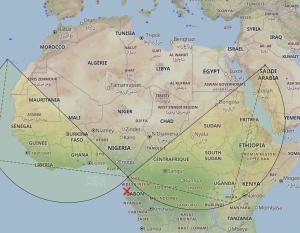
In the example above, I put a red cross in a nearly blind spot. The left semi-circle is the lower limit of what strikes can be computed between the Canary Island and my detector in Cameroon. The right part is between Saudi Arabia and my detector.
There are hundreds of detectors in Europe that can records a strong strike near the red cross but it will never be validated as all detectors are located in less than 90° (the gap is more than 270°).
There are some detection below that limit, but it requires contribution from La Réunion, Brazil, or South Africa, all of them very far.
I run a little script that query for all computed strikes between 20° west & 50° east, below the tropic of Cancer (my, WIDE, area of interest) and I'm pretty familiar with the detectors involved in this area.
Your contribution will help improving detection in South America, south Atlantic and west Africa because it will provide a better angle.
Thanks and regards,
Marc
P.S. I'm still looking for a host in eastern Africa for the same reason.
Posts: 6
Threads: 2
Joined: 2026-03-14
(2026-03-24, 01:02)cutty Wrote: BUT SOMEBODY HAS TO BE THE FIRST....!
Try the station there... what do you have to lose?
Sorry, I didn't mean to give the impression that I was on the fence about adding the station. I will do that. I'm just trying to understand how the improvement to the network could be quantified.
Posts: 1,966
Threads: 64
Joined: 2013-07-23
(2026-03-24, 17:04)gmiller43 Wrote: (2026-03-24, 01:02)cutty Wrote: BUT SOMEBODY HAS TO BE THE FIRST....!
Try the station there... what do you have to lose?
Sorry, I didn't mean to give the impression that I was on the fence about adding the station. I will do that. I'm just trying to understand how the improvement to the network could be quantified. Sure... I just can't think of a way to 'quantify' an improvement.... especially since lightning is so seasonal... an overall increase in 'South America' region strokes would be an indicator something good is happening... maybe pull in some of that Catatumbo lightning up at Lake Maracaibo that seems to escape our network for the most part... .
Posts: 64
Threads: 9
Joined: 2024-08-28
Here is another representation (I should have started here) to illustrate that in many case in southern and remote area. the limiting factor is the angle even more than the distance from the detectors.
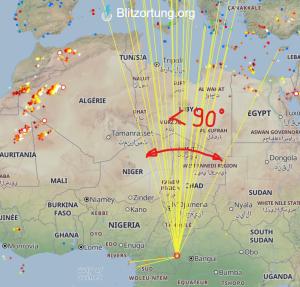
This strike was seen by more than 40 detectors in Europe, but it will not be computed without contribution from the south.
South America have a similar situation with hundreds of detectors in North America but not many that can provide the angle coverage.
The southern part of both continent are very unlucky and out of reach
New detector in Northern Brazil will help. Eastern Brazil would be great !
Hope it clarify my point.
Regards,
Marc
Not a measurement or quantification, but here is the output from the PowerShell I use to see my contribution (Not yet where I wanted to be  ):
Code: DateTime = 2026-03-25 14:39:25.179 [1774449565179551700]
lat, lon 2.108022, -8.32288
region 6 mds, mcg 7995, 259
Distance from Kribi: 2034km West (268°)
sta time lat lon alt status DistTime DistGeo Known Country
--- ---- --- --- --- ------ -------- ------- ----- -------
3111 6333081 3.76 8.78 36 16 1899 1908 ### Malabo-Ferrite ### Equatorial Guinea
3158 6786915 2.99 9.97 38 24 2035 2034 ### Kribi-Loop Atel. ### Cameroon
3084 6789532 2.99 9.97 38 24 2035 2034 ### Kribi-Loop toiture ### Cameroon
3112 6792715 2.99 9.97 41 24 2036 2034 ### Kribi-Ferrite Atel. ### Cameroon
3156 6794919 2.99 9.97 36 24 2037 2034 ### Kribi-Ferrite Atel. ### Cameroon
3157 8198582 4.58 13.67 670 24 2458 2457 ### Bertoua-Ferrite ### Cameroon
2365 10447437 34.93 32.41 574 4 3132 5567 Chypre Cyprus
2344 11727647 32.66 -16.89 395 12 3516 3514 Madere Portugal
2840 13116988 37.38 -6.01 13 12 3932 3929 Spain
1846 13362346 37.96 -8.87 59 4 4006 3987 Portugal
1045 13775203 39.23 -9.00 117 10 4130 4128 Portugal
2324 15336029 42.37 1.89 1174 4 4598 4591 Spain
1877 15404112 43.43 -3.87 37 12 4618 4616 Spain
806 16208570 41.46 12.90 20 2 4859 4864 Italy
|