Posts: 26
Threads: 4
Joined: 09/2016
Hi,
Surface elevation plots are on-line at
http://www.solwise.co.uk/wireless-elevationtool.html
I swapped out my 5v PSU for a USB battery and all of the E field noise at 38kHz and 76kHz disappeared. I then tried a nice looking 5v PSU with the correct plug from an old music player (creative zen), it looked well made and had a nice big ferrite on the DC cable. It was just as bad as the first PSU, although the frequency was higher.
I then tried an iPad PSU, which looked very clean. Then a USB charger I had to buy at an airport when I forgot my charger, also good. Finally I have a PC in the summerhouse, it's a Dell with a good metal case and high powered USB outputs, that works well too.
So currently my system blue is now plugged in to my Dell.
At the same time, I have also switched off the HP filter, it seem to be turned on by default, and this seems to have increased the signal to noise ratio on both E and H field inputs.
All in all, it is looking a fair bit better.
I just need to look at directional loops now.
Robin
Posts: 520
Threads: 18
Joined: 06/2016
(2016-10-13, 21:20)DrRobin Wrote: Hi,
Surface elevation plots are on-line at http://www.solwise.co.uk/wireless-elevationtool.html
I swapped out my 5v PSU for a USB battery and all of the E field noise at 38kHz and 76kHz disappeared. I then tried a nice looking 5v PSU with the correct plug from an old music player (creative zen), it looked well made and had a nice big ferrite on the DC cable. It was just as bad as the first PSU, although the frequency was higher.
I then tried an iPad PSU, which looked very clean. Then a USB charger I had to buy at an airport when I forgot my charger, also good. Finally I have a PC in the summerhouse, it's a Dell with a good metal case and high powered USB outputs, that works well too.
So currently my system blue is now plugged in to my Dell.
At the same time, I have also switched off the HP filter, it seem to be turned on by default, and this seems to have increased the signal to noise ratio on both E and H field inputs.
I just need to look at directional loops now.
Terrain plotting link saved, thanks.
Various comments in these forums (fora?) indicate that units from Apple are good. However my quiet one is from TP-Link. Running a PC to power a controller seems a bit OTT, the fans alone will be using more power than the than the controller! Blues only draw about 350 mA @ 5 V or 1.75 W.
The HP filter has some gain associated with it see the end of:
Noise spikes on board, System Blue
The omni / fig 8 combination is sound theory. One 20 turn loop is now a 4 turn loop to get the level of Anthorn down to a level similar to the horizontal loop. If connecting the two loops together makes a noticeable difference I haven't noticed it yet. The other, obvious if you think about it, thing is that the 4 turn loop barely picks up any wanted signals. If it worked to generate a signal to create a cardioid polar pattern I'd put up with that. You'd still get the signals picked up on the horizontal loop. I guess it's not working as the two signals are not close enough in phase/wave form.
May have a bit more of a play, glad I made the array easy to mount/dismount
Cheers
Dave.
Stations:
1627
Posts: 26
Threads: 4
Joined: 09/2016
Hi,
Just read your 'New Station post' with interest. I hadn't realised that Anthorn also transmitted 60kHz. I see what you mean about noise. I am going to have to look at the spectrum of my signals carefully as one of my loops picks something up around 60kHz and I am sure it is the loop pointing towards Anthorn.
I currently have my loops arranged North/South (null towards Anthorn) and roughly North West/South East. The second loop is a compromise between coverage in to central Europe and reducing the pick up from Anthorn. This combination seems to work reasonably well. Facing the second Antenna East/West doesn't make too many detections. Perhaps the same would work for you?
I have also been fiddling with the HP filter on and off. It is currently on and seems to improve the stroke rate, although everything I read suggests it should be off unless 50Hz is a problem, which it isn't here.
My E-field antenna noise has reduced with the change in PSU, but it is the worst performing antenna of the three. Perhaps it is not high enough? My system blue is currently back in the summerhouse and the PC is already there (automated night sky camera/weather station), so it's USB ports are for free.
If I move my system blue back in to the loft (perhaps tomorrow) then I will be back to the iPad PSU. I have to use a wireless router to link either summerhouse or loft to my main router so need power for this as well.
Posts: 520
Threads: 18
Joined: 06/2016
I think it's easy to get a bit paranoid over interference and noise. I have to do something about Anthorn and Skelton as they are so blooming loud and more or less within the range of frequencies we are interested in. I'm less worried about Noviken and Rosnay as they are not very strong or MSF on 60 kHz from Anthorn or GYN2 on 81 kHz from Inskip as they are well out of the band of real interest.
One loop will have its null split between Skelton/Anthorn, the only way to have at least one capable of hearing anything else. ATM all three loops are on the same frame and arranged at 90 degrees to each other, so the other vertical loop gets the full "benefit" of Skelton/Anthorn. After yesterdays little play it needs rewinding... I think it will get rewound onto another frame and I'll make another mount/bearing for it.
E field is connected but doesn't do a lot but then it's in the loft, nearer horizontal than vertical and the controller isn't grounded. I'm not sure orientation makes a great deal of difference as the E field is more of a sensor/probe than a real receiver. As it's a sensor/probe adding a reference ground is probably a good idea, provided it's a fairly "clean" ground. Ours probably is as it's derived at the pole carrying the transformer that feeds only us, all be it with a combined N-E from the pole to house.
Cheers
Dave.
Stations:
1627
Posts: 26
Threads: 4
Joined: 09/2016
Hi,
I made a scope probe for my iPad and took some spectrum plots last night of the noise at my location.
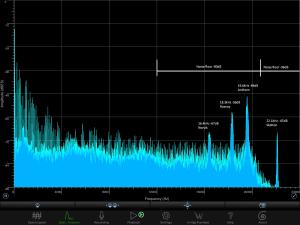
Norvik - 16.4kHz -67dB (13dB over the noise);
Rosnay - 18.3kHz -56dB (24dB over the noise);
Anthorn - 19.6kHz -49dB (31dB over the noise);
Skelton - 22.1kHz -65dB (31dB over the noise).
(Note the frequency response tails off on an iPad over 20kHz, even though it was sampled at 48kbits/sec.
I have order LTC filter chips to try to reduce this. If I look on the scope view 19.6 & 22.1kHz dominates the background noise, so might try filtering over 18kHz first.
Robin
Posts: 26
Threads: 4
Joined: 09/2016
Hi,
I re-took my spectrum plots with a decent earth on the scope probe and all of the 50Hz noise (+ odd harmonics) went. The signal strength of the interference is even stronger now compared to the noise.
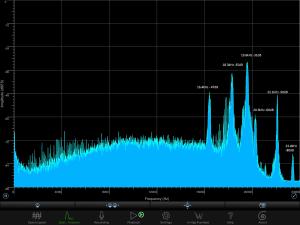
Norvik - 16.4kHz -47dB (25dB over the noise);
Rosnay - 18.3kHz -35dB (38dB over the noise);
Anthorn - 19.6kHz -31dB (42dB over the noise);
Skelton - 22.1kHz -50dB (40dB over the noise).
I can also see two new sources
20.3kHz (Isola di Travolara, Italy?) -60dB (15dB over the noise)
23.4kHz (Rhauderfehn Marinefunksendestelle, Germany) -80dB (10dB over the noise)
(Frequency data from
http://www.mwlist.org/vlf.php)
Hope my filter ICs arrive tomorrow.
Robin
Posts: 520
Threads: 18
Joined: 06/2016
(2016-10-19, 17:55)DrRobin Wrote: The signal strength of the interference is even stronger now compared to the noise.
The noise floor is roughly the same just under -72, but the absolute level of them all has gone up by 18 dB (assuming nothing has be tweaked anywhere between the plots). Now is that noise floor the actual noise floor of the receiver or of the iPad? What happens to the noise floor if you short the input? It ought to fall if you are seeing the noise floor of the receiver. The VLF transmitters going up in level and others being detected means that the receiver has better sensitivity. It should therefore receiver fainter signals.
(2016-10-19, 17:55)DrRobin Wrote: I can also see two new sources
20.3kHz (Isola di Travolara, Italy?) -60dB (15dB over the noise)
23.4kHz (Rhauderfehn Marinefunksendestelle, Germany) -80dB (10dB over the noise)
(Frequency data from http://www.mwlist.org/vlf.php)
Not sure that site is particularly up to date it only lists 81 kHz from Skelton. The VLF from Skelton started in 2001 and other sources (including these forums) have 81 kHz GYN2 as Inskip.
Cheers
Dave.
Stations:
1627